AI in 2026 Is the Most Dangerous Technology Humanity Has Approached, Bill Gates Warns
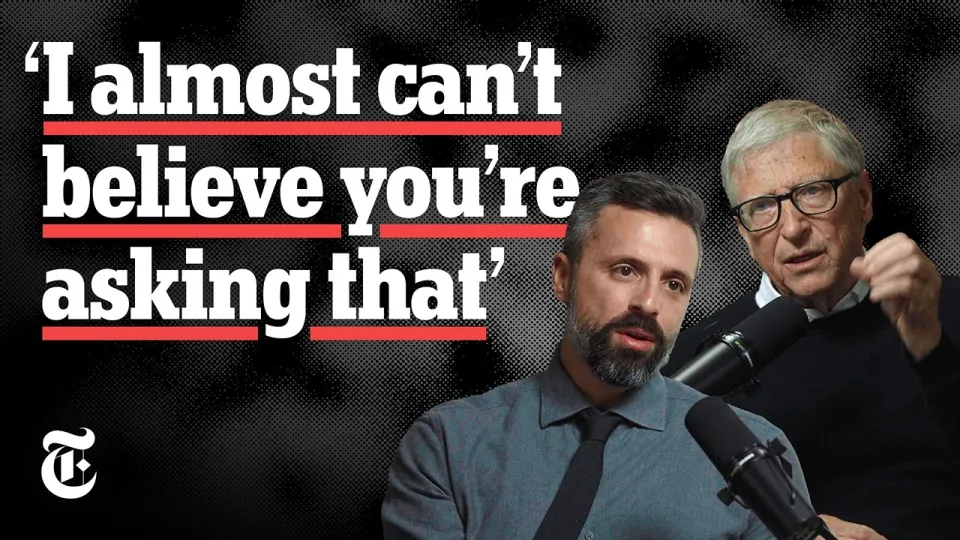
Video: Bill Gates: A.I. ‘Makes Nuclear Weapons Look Like Nothing’ | The Ezra Klein Show
Want articles like this for your own video to promote it on YouTube and Google? Order them through the Telegram bot @sat_sit_bot. Articles with your video embedded are written and posted by the bot itself — on popular topical sites (no ads). Try it free: 50 articles on us.
· based on the channel The Ezra Klein Show
Key takeaways
- Gates calls AI the most dangerous thing humans have ever approached, saying it makes nuclear weapons look minor by comparison.
- He names two thresholds — cyber and bio — where AI could enable attacks at a scale no lawsuit or market incentive can answer.
- Gates says the idea that AI companies can self-regulate is "insane" and that government action is required.
- The Gates Foundation, set to spend down about $200 billion over two decades, has made AI-driven inequality a new priority.
- He flags mass job loss and developing-nation disruption as near-term economic consequences, not distant hypotheticals.
Bill Gates argues that AI is the most dangerous technology humanity has ever approached, and that the danger is understated rather than exaggerated. In a conversation with Ezra Klein, he says the years ahead will bring catastrophic cyberattacks, bio-terrorism and mass job loss unless governments act, and he calls the belief that the AI industry can regulate itself "insane." The full transcript and episode are available at the New York Times page for the Ezra Klein podcast.
What Gates actually means by "makes nuclear weapons look like nothing"
The comparison is not rhetorical inflation but a claim about scale and access. Nuclear weapons require fissile material, enrichment infrastructure and nation-state budgets; a model that helps design a pathogen or write an exploit requires a laptop and an API key. Gates's point is that AI collapses the cost of certain kinds of harm while leaving the number of capable actors effectively unbounded.
He separates the risk into two thresholds that he treats as the practical line for policy:
- Cyber. AI that can find and exploit software vulnerabilities faster than defenders can patch them, at a volume that overwhelms human security teams.
- Bio. AI that lowers the barrier to designing or acquiring dangerous biological material, moving capability from state labs toward small groups or individuals.
In both cases the harm is not a single dramatic event but a shift in the ratio of offense to defense. Gates's framing in the interview is that once those thresholds are crossed, the consequences are not something a company can absorb or a court can unwind.
Why Gates says self-regulation is "insane"
The argument against industry self-regulation rests on incentives, not competence. Gates does not claim AI labs are staffed by reckless people; he claims that firms competing in a race cannot unilaterally slow down, because the cost of restraint falls entirely on the firm that restrains. A voluntary pledge holds only until a competitor decides it does not.
His sharpest moment in the episode comes when the idea of addressing catastrophic harm through litigation is raised. The response — essentially that a body count in the tens of millions is not something you settle in court — captures the core objection: liability is ex post, and the risks under discussion are irreversible. Regulation has to be ex ante, and it has to be binding.
This is also where Gates breaks with a widely circulated Silicon Valley view, associated with Nvidia's Jensen Huang, that market incentives and capitalism will naturally produce remedies for harmful products. Gates's career was built inside that market, which is why the disagreement reads as a judgment from experience rather than ideology.
The race with China and the safety-versus-speed tradeoff
Gates treats the US–China dynamic as the main reason safety arguments lose politically. Any unilateral slowdown by one country is framed as a gift to the other, which makes restraint domestically costly even when the technical case for it is strong. The result is a race in which both sides can justify acceleration.
His proposed escape from that trap is coordination rather than unilateral pause: shared thresholds, shared verification, and rules that apply to capability rather than to nationality. He is explicit that this is harder than it sounds and that he is not confident it happens in time — the interview's tone is one of concern about readiness, not optimism about outcomes.
Jobs, inequality and the "no-scarcity" labor market
Beyond existential risk, Gates spends substantial time on economic disruption, and his framing is more specific than generic automation anxiety. The concern is not that work disappears but that it disappears faster than institutions can redistribute the gains.
He raises several ideas that recur in the conversation:
- Taxing AI labor. If machine output substitutes for human wages, the tax base that funds social programs erodes unless the new production is taxed somewhere.
- "Human reserved" jobs. Deliberate categories of work kept for people, as a policy choice rather than a market outcome.
- A no-scarcity job market. The possibility that abundance in goods and services coexists with a collapse in the bargaining power of labor.
- Developing nations. Countries whose growth path depended on labor-intensive services may find that path closed before they arrive at it.
Gates links this directly to his foundation's new priority: steering AI toward equality rather than inequality. The foundation is set to spend down roughly $200 billion over the next two decades, and he has said that shaping AI's distributional effects is now part of that work.
Where the audience pushed back
Viewers of the episode converged on a few recurring doubts. One is the credibility of the warning itself: a technologist who built one of the largest companies in history now arguing that the next technology needs to be constrained invites the charge of hypocrisy. Gates's answer in the interview is essentially that the comparison is not to a world without AI but to a world where deployment outpaces safeguards.
A second doubt is whether alarm is useful at all when the people in authority appear to dismiss it. The striking reaction from listeners was that Gates seemed more agitated than usual and less willing to soften his answers — and that the officials he describes are in denial rather than disagreement.
A third is the litigation question, which drew the most attention: if a system causes mass harm, who is liable, and can any legal process meaningfully respond? The interview's position is that the answer has to be preventive, because the alternative is a remedy applied after the damage is permanent.
Education, children and the slower-moving risks
Gates also addresses AI in schools, where the risk profile is different: not catastrophe but dependency and learning loss. He notes that rich countries were already struggling with learning loss before generative tools became ubiquitous, and that AI can either tutor effectively or substitute for the cognitive work that produces skill.
He argues for age-specific rules for children's use of AI, treating minors as a distinct regulatory category rather than leaving design choices to product teams. This is one area where he suggests regulation is comparatively easy — the harms are visible, measurable and reversible, unlike the cyber and bio thresholds.
Useful links
The primary source for this analysis is the episode transcript and audio, plus the show's running list of guest book recommendations.
- Full transcript and episode page for the Bill Gates conversation
- Book recommendations from Ezra Klein Show guests
The bottom line
Gates's position is that AI risk is not a distant hypothetical to be managed by voluntary pledges and post-hoc lawsuits, but a near-term policy problem requiring binding rules on cyber and bio capability. The interview is notable less for new predictions than for the intensity of the warning and the explicit rejection of self-regulation as a serious answer. Listeners came away with the sense that a technologist who spent a career betting on software is now betting against the industry's own judgment about speed. The conversation was produced by The Ezra Klein Show, and the full episode is worth hearing in Gates's own words rather than in summary.
Source: Bill Gates: A.I. ‘Makes Nuclear Weapons Look Like Nothing’ | The Ezra Klein Show · Markdown version
Questions & answers
Why does Bill Gates compare AI to nuclear weapons?
He is pointing at access and scale rather than raw destructive power. Nuclear weapons require enrichment infrastructure and state-level resources, while AI capability that enables a serious cyber or bio attack can be held by a small group with ordinary computing. Gates argues that once those thresholds are crossed, the offense-defense balance shifts in a way no legal process can correct after the fact.
What does Gates propose instead of industry self-regulation?
Binding government rules tied to capability thresholds, particularly for cyber and biological risk, plus coordination between major powers so that restraint by one country is not treated as a gift to another. He rejects voluntary pledges because a firm that slows down alone bears the full competitive cost while the risk remains shared.
Is Gates worried about job losses or only about catastrophic risk?
Both, and he treats them as linked. Mass job displacement, erosion of the tax base that funds social programs, and disruption in developing economies are near-term effects in his account. He raises ideas such as taxing AI-driven production and designating certain roles as reserved for human workers.
What role does the Gates Foundation play in AI?
The foundation, set to spend down around $200 billion over two decades, has made steering AI toward equality a new priority. That means focusing on how the technology is distributed and who captures its gains, rather than only on the capabilities themselves.